Finding Wonder in the Smallest Surprises
Building biodiversity is a key component of regenerative farming. When nature inspires how we design our food systems, a colorful cast of characters is bound to follow. That’s why we’re always excited to spot an unfamiliar or eye-catching insect in the field!
Don’t be fooled by their small stature: insects can provide a lot of ecological insights. In documenting both new and frequent sightings, we’ll explore questions like: Who do they eat? Who eats them? What habitats do they prefer? What plants do they depend on? If some consider them a “pest,” why? Is the judgment valid? Might there be a missing check – a predator or parasitoid, say – that could quell their impact? The vast majority of insects – many say over 99% – are harmless or beneficial to humans, so it’s worth taking the time to better understand those with whom we share our garden and farm ecosystems.
The 2026 growing season has been no exception for spotting cool bugs with even cooler life histories. Below are a few of the latest visitors to greet our staff, students, and volunteers this year. As you’ll see, even the smallest creatures can fill us with wonder, giving us countless pathways to connect with our local landscape.
Walnut Sphinx Moth (Amorpha juglandis)
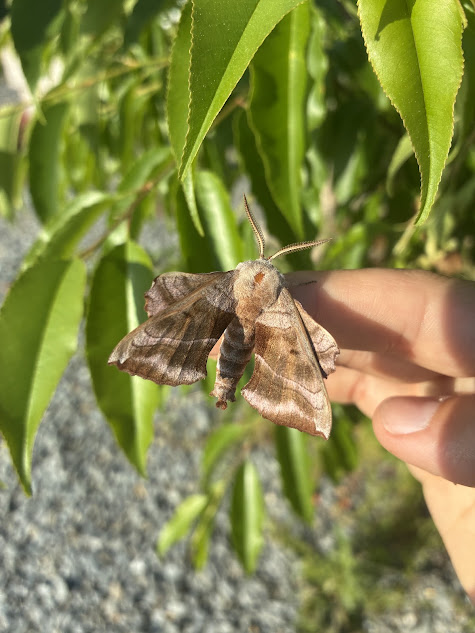
With so many black walnut trees surrounding our growing field, the name for this common moth came as no surprise. As caterpillars, walnut sphinx moths eat the leaves of black walnut (Juglans nigra) and related trees like butternut and hickories. Interestingly, they also consume hazelnut leaves. The Horn Farm’s multifunctional riparian buffer includes hundreds of American hazelnuts (Corylus americana) planted to protect sensitive land while producing edible nuts. So, if nothing else, the Horn Farm apparently provides pristine reproductive habitat for Amorpha juglandis!
But this quaint lepidopteran – belonging to the order of insects that includes butterflies, moths, and skippers – comes from surprisingly ferocious stock. Walnut sphinx moth caterpillars are known to thrash, bite, and even squeal when distrurbed. While the squealing reaches frequencies undetectable by the human ear, birds perceive the sounds and may become startled enough to skip the screaming caterpillars for their next meal.
But all this protest isn’t just pandemonium. Researchers have noticed how the caterpillar’s squeals resemble avian alarm signals, similar to those used by birds to communicate the presence of nearby predators. So it’s possible that the caterpllars are deflecting hungry birds by employing false alarms. Mimicry or chaos, this adaptation proves useful for keeping bird pressure at bay, allowing many caterpillars to survive the treacherous journey to becoming moths.
Eastern Elderberry Borer (Desmocerus palliatus)
American black elderberry (Sambucus canadensis), like American hazelnut, is a hallmark of the Horn Farm’s learning landscape. Dozens of class participants and volunteers have helped our team to plant, tend, and harvest hundreds of elderberries over the years, with the goal of creating a healthier farm ecosystem while demonstrating agroforestry to our community.
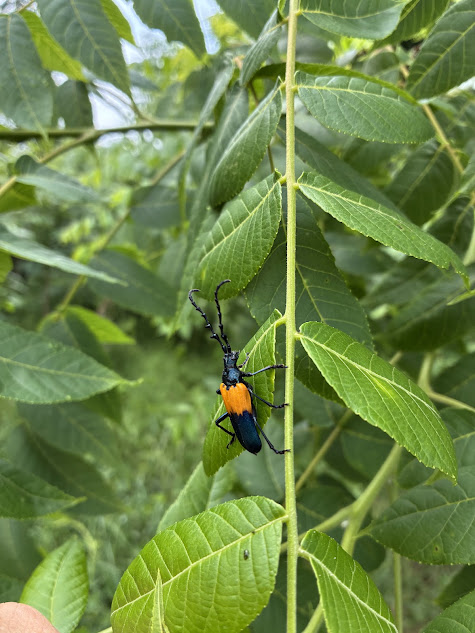
So, swimming as we are in a sea of elderberries, one would expect us to come across something like the eastern elderberry borer more often. This insect has an exclusive (or as ecologists would say, obligate) relationship with elderberry, requiring it for feeding and reproduction. But it turns out the elderberry borer is elusive, even for entomolgists. Many accounts describe it to this effect: “not uncommon, but rarely seen.”
The eastern elderberry borer is a species of longhorn beetle (Cerambycidae), and among the most visibly striking of this group. Its draping, iridescent wings are crowned with brilliant orange, a type of warning coloration designed to signal toxicity to birds and other predators. Some insects merely mimic warning coloration – like the viceroy butterfly vis-à-vis the monarch – but the elderberry borer may truly be noxious. Since elderberry leaves naturally contain toxic cyanogenic glycosides, the feeding insect can accumulate these toxins and render itself undesireable to predators. Cyanogenic glycosides, by the way, are the same compounds that make elderberry leaves and raw fruits inedible to people. They transform into hydrogen cyanide when consumed. When processing elderberry fruit for medicine, we have to cook or dry them to neutralize the toxins and reap elderberry’s incredible immune-boosting benefits.
Now, if an insect called a “borer” rings any bells, you may be thinking of the emerald ash borer (Agrilus planipennis). This recent newcomer to North America has decimiated ash tree populations. As the name suggests, borers burrow beneath the bark of their host trees, creating holes and tunnels while feeding on essential nutrients. But not all borers are built the same. While it’s true that the larvae of the elderberry borer carve tunnels through elderberry as part of their life cycle, healthy stands of elderberry are rarely overwhelmed. Thanks to a long history of co-evolution and the borer’s generally low populations, there isn’t reason to believe this visitor poses any major encumbrance to our goals. With vigorous elderberries in an increasingly diversified community of plants and food webs, the eastern elderberry borer is simply another member of the whole.
White-Marked Tussock Moth (Orgyia leucostigma)
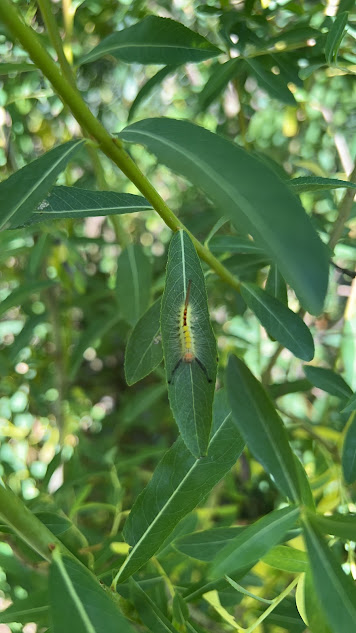
This whimsical caterpillar was found clinging to a willow leaf in our basketry willow plot, making for a third new sighting among the agroforestry plantings. In fact, a volunteer discovered it while we harvested willow stems for make-your-own flower crowns at our Summer Solstice Market!
We left this stem uncut, and keenly so. Despite its rather Seussical appearance, this caterpillar is known to cause contact dermatitis, even leaving a rash on sensitive skin. That’s because of the arsenal of barbed hairs found across it’s body. These are concentrated in the antennae-like structures portruding from both ends and the four puffed clumps lining its abdomen. Even the protective cocoons these caterpillars spin during metamorphosis can cause irritation when touched!
Unlike the pickier insects above, the tussock moth is a generalist when it comes to feeding. They’ve been documented eating the foliage of over 140 plant species, primarily trees, both deciduous and coniferous. In fact, when localized population surges do occur, they can be pinned as pests in orchards and tree farms. But outbreaks are generally limited to a single season, and a healthy mix of predators, parasitoids, and pathogens – encouraged by a diversity of plants – can help prevent incursions in the first place.
It might seem unusual that the female moths are naturally flightless, a condition called brachyptery. In a world where dispersing genetics is generally encouraged, doesn’t this pose a disadvantage? As it turns out, the caterpillars themselves compensate for this shortcoming. Thanks to their ability to create short strands of fine silk, very young caterpillars can make like balloons, catching a good breeze and floating to new feeding sites. Appropriately, this travel technique is called ballooning. And with well over a hundred plant species on their menu, tussock moths are bound to land someplace where they can find a bite to eat – like the willow patch at the Horn Farm.
Black Swallowtail Caterpillar (Papilio polyxenes)
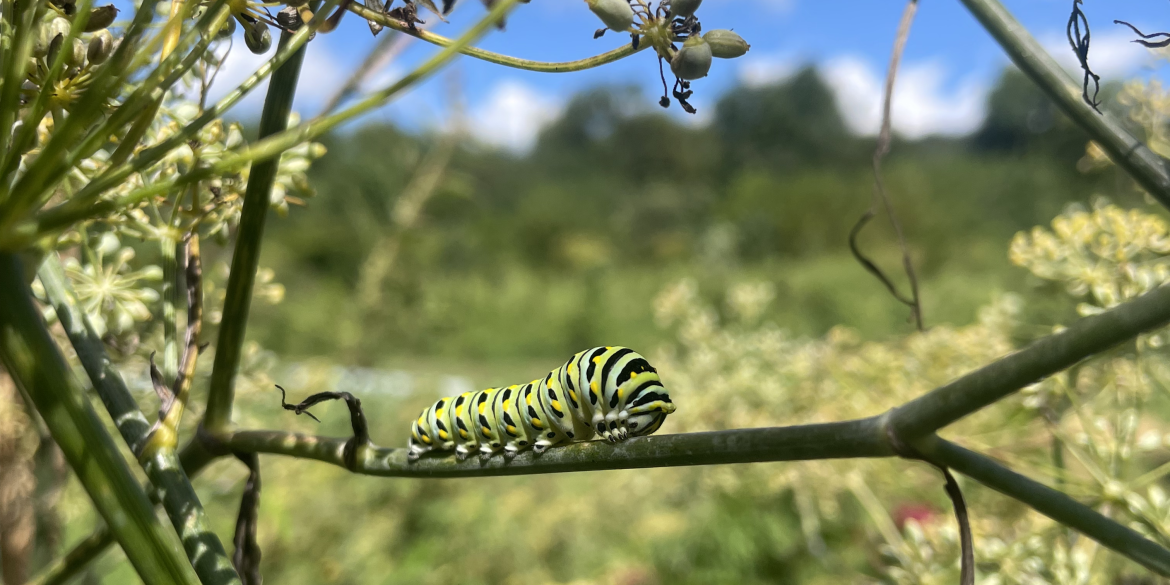
Compared with the insects above, the black swallowtail caterpillar is a relatively common find during the summer. The same goes for its stunning adult form, often seen flitting among the pollinator plots planted by our Ecological Gardener Training Program students over the years. But despite its frequency, we’re always willing to pause and admire this charming visitor to our vegetable and herb beds.
Gardeners who grow plants in the carrot family, Apiaceae, likely share our familiarity with the black swallowtail. Caterpillars feed exclusively on members of this botanical grouping, which includes celery, dill, fennel, parsley, and, of course, carrot. Apiaceae also includes wild and feral kin to our garden staples. Alongside golden alexander, wild parsnip, and Queen Anne’s lace (or wild carrot), it’s not uncommon to find black swallowtail caterpillars nonchalantly dining on some of North America’s deadliest plants, like poison hemlock and water hemlock. As any forager knows, one being’s dinner could be another’s trip to the ER!
Like the white-marked tussock moth, the black swallowtail caterpillar packs a bigger punch than its appearance suggests. Lacking in hairy armor, it conceals a secret, smelly weapon. When threatened, the caterpillar can retract its head and expose a pair of orange horns called osmeteria. The bright coloration of these horns acts as a visual warning, and they emit a foul-smelling secretion that helps to repel attackers.
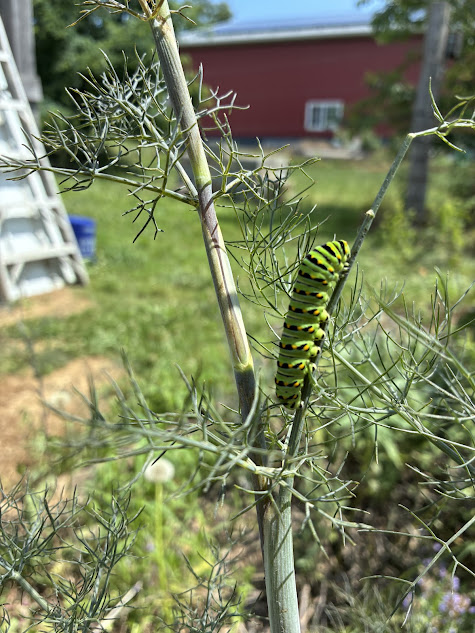
While mature caterpillars employ this dramatic line of defense, younger caterpillars are a bit more subtle. Many people fail to recognize the early black swallowtail caterpillars as the same species, because they are very dark and spiny with a white splotch mark mid-way down their abdomen. These features may mimic bird droppings, helping them go undetected until they grow into their greener, more recognizable form. These incredible adaptations – visual, aromatic, and otherwise – help many caterpillars complete the perilous journey to pupation, after which they emerge as the iconic butterflies we associate with the summer.
Small Wonders Abounding
Growing food in ecological ways nourishes more than just the body. When we use nature’s designs to create diverse edible ecosystems, other benefits flutter, crawl, and inch our way. A lengthy summer day tending plants and harvesting food is always brightened when we find these signs of life. They may be small, but in filling us with curiosity, wonder, and admiration for the living world, they help to nourish our connection to the local landscape.
We’re grateful for the insects who surprise us each day. We’re also grateful for the students, volunteers, and other members of the Horn Farm community who share our fascination! Check out upcoming ways to get engaged with our educational ecosystem:
- Registrations Open: 9-Day Forest Garden Design Intensive with Dave Jacke (Oct 16 – 25, 2026)
- Now Accepting Applications: 2027 Regenerative Grower Training Program (begins Feb 16, 2027)
- Learn More: 2027 Training Programs


 Wine cap mushrooms, also known as Stropharia rugosoannulata, garden giants, or king stropharia, are one of the easiest edible mushrooms to cultivate. They thrive on decaying matter, like the woodchips we often use in garden pathways and landscaped beds.


