Amazing local food, one-of-a-kind crafts, and a shared love for nature: we’re thrilled to once again bring these things together for the 2023 York County Pawpaw Festival, taking place on Saturday, September 23rd and Sunday, September 24th from 10am to 3pm at the Horn Farm Center!The Pawpaw Festival is entering its 19th year and has truly become an annual attraction. Last year, we welcomed over 2000 visitors from near and far to enjoy the wild and uncommon flavors of the York and Lancaster regions. This year, we’re enhancing the visitor experience with ONLINE TICKETS – available beginning August 1st, 2023 at hornfarmcenter.org/pawpawfest/
Purchasing a ticket in advance will guarantee your admission to this year’s festival. We’re offering two levels of admission:
Premium Pass: includes admission to one day of the Pawpaw Festival, a t-shirt designed by a local artist, and automatic entry into a door prize drawing for Horn Farm Center class vouchers.
General Pass: includes admission to one day of the Pawpaw Festival.
Stay tuned for updates about NEW educational programs, vendors, and other details about the 2023 Pawpaw Festival presented by Horn Farm Center and Explore York.
Mark your calendar to purchase your tickets, going live on August 1st!
Can’t get enough of that delicious pawpaw flavor? This year, the Horn Farm Center has partnered with John Wright Restaurant to offer a wild and uncommon culinary adventure on Friday, September 22, 2023 – the evening before the Pawpaw Festival.
The Horn Farm’s Pawpaw Experience at John Wright Restaurant will feature a 3-course pawpaw-themed dinner with two drink pairings.
Stay tuned! Tickets and more information will be announced in August.
Restoring land and reviving ecosystems takes time and a team. That’s why the Horn Farm Center’s new volunteer program offers more ways to engage with nature and regenerative land stewardship.
The Horn Farm Community Crew program provides hands-on volunteer training with Horn Farm staff.
Perks of membership include ongoing training and education with experienced staff, a free t-shirt, volunteer social events, and the ability to log hours spent volunteering to redeem free class vouchers and other perks.
New “Wild Lands” Primitive Skills Intensive & Weekly Series
Are you ready to reconnect to the land and develop essential survival skills? Horn Farm Center’s “Wild Lands” programs explore primitive skills and invite us to connect more closely with both nature and our human ancestry.
This fall, we are offering our Wild Lands series in two formats:
Weekly Workshop Series: 5 full-day workshops starting on October 1st and ending on October 29th.. These classes take place each Sunday in October from 9AM to 4PM. Register for individual days or the entire weekly session.
4-Day Intensive: Runs Sunday, October 1st through Wednesday, October 4th from 9AM to 4PM. This format provides a more immersive deep dive into primitive survival skills.
Students will gain hands-on experience with basic, pre-industrial, woodland-style survival skills. This includes gathering wild foods, building debris-huts, animal tracking, fire-making techniques such as hand-drill and bow drill, making basic hunting implements such as a survival bow and simple traps, and much more!
Whichever format works best for you – join us for our fall Wild Lands programs starting October 1st at the Horn Farm Center!
Beaver-y excited for the Horn Farm Center’s NEW youth education program, Becoming the Animal, for children ages 9 to 12!
This three day series, taking place from Monday July 31st to Wednesday, August 2nd from 9am to 12pm is an opportunity for children to learn about animal behavior and ecology through the lens of three unique and important animals—one of which is the beaver!
Among very few animals to redesign their habitats, beavers play essential ecological roles: the dams they build foster habitat for countless aquatic species, prevent erosion and flooding, and sustain water table levels.
But why would beavers build such complicated structures in the first place? Aside from their need for comfortable lodging that stores their food and protects them from predators, researchers have found that beavers’ motivation to build arises from their aversion to the sound of running water!
From capturing sediments, pollutants, and carbon upstream to healing water and habitat downstream, it’s apparent that our impetus for bringing 17,000 trees and shrubs to the edges of our creeks comes from the awareness of a beneficial feedback loop that ripples outward.
At home, we can do our part to slow erosion, uptake more water, create more shade, and support a myriad of birds, insects, and aquatic life. At the same time, by helping lands and waters at home, we take the responsibility necessary to address an ailing Susquehanna River and Chesapeake Bay. Land care travels like water: fluid and pooling. In time, the small becomes sweeping.
But while the ecological benefits of riparian buffer planting are promising, it’s important for us to avoid positioning ourselves as sidelined observers of these benefits. We are, of course, not just nature sentimentalists: we are embedded in and dependent on the land that we are restoring.
Capturing water and mitigating pollutants directly impacts our wellbeing; our breathing sways in time with the respiration of the green life around us; insects pollinate our food and nurture these soils. The land has always provided more materials for humans than our modern imaginations can fathom.
It’s essential that we recognize these facts as climate change pushes us into increasingly unfamiliar terrain and challenges the standard of living we’ve taken for granted. Recognizing the services of our local landscapes, and RE-localizing our impacts, are the steps we need to take to secure a livable future.
With this vision of a functioning ecosystem that thrives not in our absence, but in our presence, the Horn Farm’s riparian buffers become more than healing spaces for the land.
They’re a learning spaces too. We’re learning (or better, re-learning) ways to unite the needs of natural cycles with the material and caloric needs of people nearby. It’s a vision reconciling abundance in a world where ecological and societal wellbeing are often polarized: we CAN prioritize the protection of water, soil, and habitat while supplying goods for people, with annual harvests that actually promote the health of the buffer. Luckily for us, there is a word predating our work that describes this mosaic of purposes: multifunctional.
“I had very little background knowledge in ecological or environmental concepts. I enrolled in the Land Stewardship Program for an introduction. Classes were stimulating, organized, and enjoyable. The program has inspired me to pursue additional training with a goal of a new direction in my career path!
– Karen Kaslow, 2023 Land Steward Training Program Graduate
Our Training Program instructors are now planning for 2024.
If you’re interested in our training programs and would like to be added to the waiting list, please fill out the form below. Wait list contacts will be the first to know when registrations go live this summer!
Looking to gain professional experience in horticulture and greenhouse management? Applications for the Horn Farm Center’s 2024 Greenhouse Management Internship are now open!
Interns will spend eight hours a week from February to May working alongside our Farm Manager in all aspects of greenhouse propagation, from production planning and seeding to overseeing the Horn Farm’s annual Plant Sale. Areas of focus include the day-to-day practices of nursery plant production, basic plant biology and anatomy, organic methodologies, and perennial propagation.
Scurry like a squirrel, build like a beaver, and move like a mastodon this summer at the Horn Farm Center!
This three-day program series is an opportunity to learn about animal behavior and ecology through the lens of the animal! Students will learn about squirrel, beaver, and mastodon by studying their habitat, life cycles, and behaviors. Each day, students will explore how these animals move in the landscape through fun, engaging activities and then they will become the animal by mimicking their behavior on the land while discovering how these animals play an important role in our ecosystems.
Join us on July 31- August 2nd from 9AM-12PM for Becoming the Animal Summer Series! Parents are encouraged to stay and attend the program, or we offer a drop-off and pick-up 30 minutes before class begins and ends.
For the Whole Stream is the first installment of a new series called the Horn Farm Ecosystem. Through periodic articles, we’ll walk the land in writing: visiting the forests, regenerative fields, and ecological action sites of the Horn Farm Center to explain our stewardship work, uplift nature, and inspire love for the land.
“… riparian buffers represent another example of an agroforestry system that’s a win-win for ecological outcomes and community well-being and livelihoods.”
Our visits to the Horn Farm’s riparian buffer in this blog series have covered the extensive environmental benefits of restoring plant life in streamside areas. From capturing sediments, pollutants, and carbon upstream to healing water and habitat downstream, it’s apparent that our impetus for bringing 17,000 trees and shrubs to the Horn Farm Center comes from the awareness of a beneficial feedback loop that ripples outward. At home, we can do our part to slow erosion, uptake more water, create more shade, and support a myriad of birds, insects, and aquatic life; at the same time, by helping lands and waters at home, we take the responsibility necessary to address an ailing Susquehanna River and Chesapeake Bay. Land care travels like water: fluid and pooling. In time, the small becomes sweeping.
But while the ecological benefits of buffer planting are promising, it’s important for us to avoid positioning ourselves as sidelined observers of these benefits. We are, of course, not just nature sentimentalists: we are embedded in and dependent on the land that we are restoring. Capturing water and mitigating pollutants directly impacts our wellbeing; our breathing sways in time with the respiration of the green life around us; insects pollinate our food and nurture these soils. The land right around us has always provided more materials for humans than our modern imaginations can fathom. It’s essential that we recognize these facts as climate change pushes us into increasingly unfamiliar terrain and challenges the standard of living we’ve taken for granted. Recognizing the services of our local landscapes, and RE-localizing our impacts, are the steps we need to take to secure a livable future.
With this vision of a functioning ecosystem that thrives not in our absence, but in our presence, the Horn Farm’s riparian buffers become more than healing spaces for the land.
They’re learning spaces too. We’re learning (or better, re-learning) ways to unite the needs of natural cycles with the material and caloric needs of people nearby. It’s a vision reconciling abundance in a world where ecological and societal wellbeing are often polarized: we CAN prioritize the protection of water, soil, and habitat while supplying goods for people, with annual harvests that actually promote the health of the buffer. Luckily for us, there is a word predating our work that describes this mosaic of purposes: multifunctional.
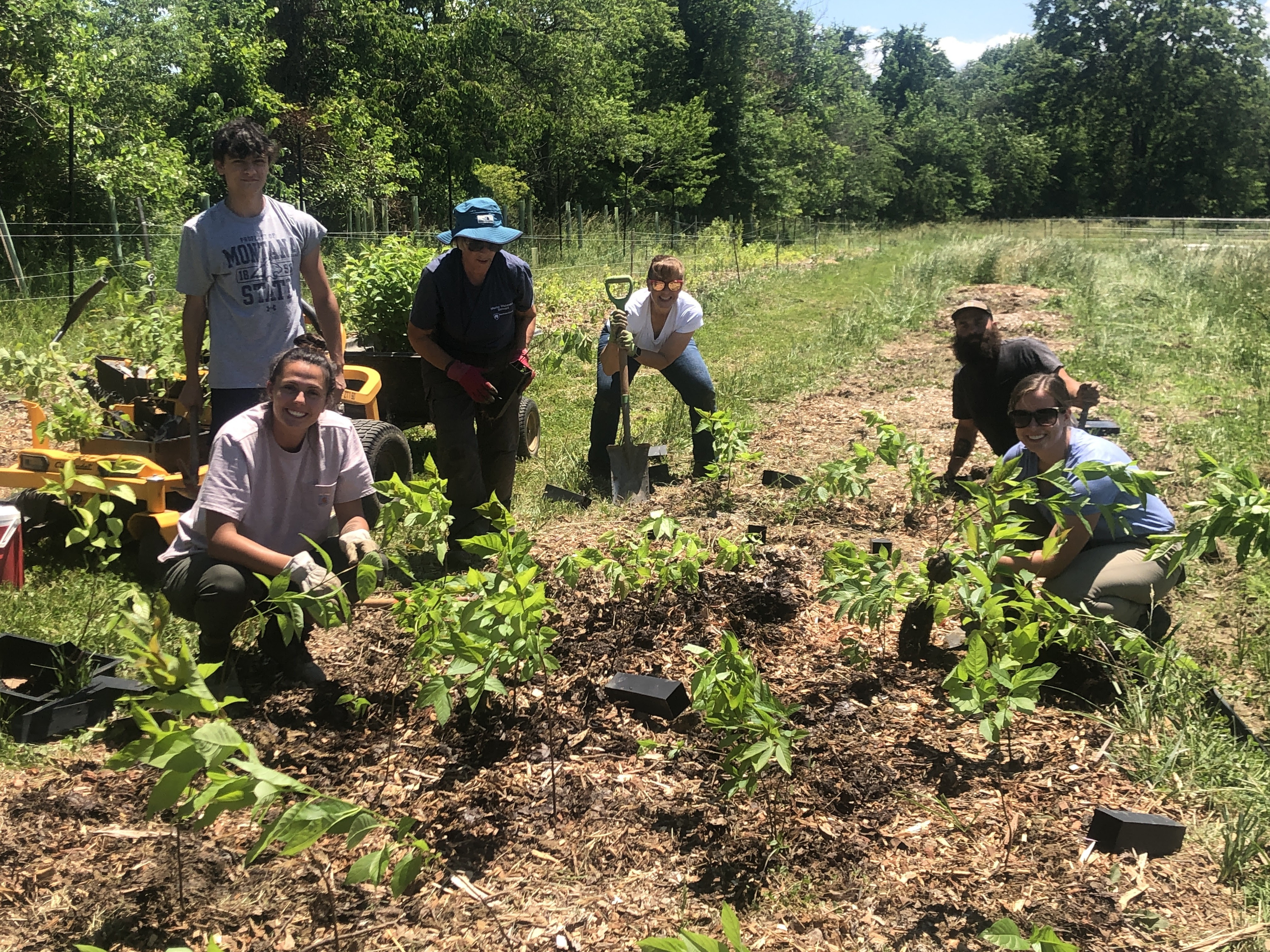
Volunteers helping out at a buffer planting workday in in the spring of 2021.
View of a vegetated area in the riparian buffer, July 2023.
The What and Why of Multifunctional Riparian Buffers
Generally speaking, a multifunctional riparian buffer is a vegetated streamside zone that improves and maintains stream health while providing direct and material benefits for the people who interact with them. These benefits often include perennial fruit and nut crops, raw natural goods like lumber and fiber, and other products that can be harvested year after year for use on site or to garner additional income.
Pennsylvania has a history of state-wide initiatives to incentivize riparian buffer planting on stream-adjacent agricultural lands, but the multifunctional appeal is a relatively new addition. In many ways, it’s strategic. One of the state’s original programs for funding buffer installations–the Conservation Reserve Enhancement Program, or CREP–prohibits farmers from generating income from the buffers it finances. While this is positive for the wild spaces it compensates, it’s a tough sell. Many farmers, especially those that operate on a small-scale, are reluctant to sacrifice acreage that could be used for crop yields. Additionally, while some to all of the planting costs are covered by the program, farmers are expected to handle the upkeep required for their riparian areas to succeed–a tall ask for folks who are already juggling demands. Taking farmland out of production like this easily sours the taste of ecological restoration despite its virtues, partly contributing to the decline in enrollment that has recently pressured the state to explore other possibilities for meeting its targets.*
So, in PA’s latest efforts to “reboot” riparian restoration, multifunctional buffer design has catapulted to the front of incentives available to streamside farmers. At the very least, it’s having a moment. From a purely economic standpoint, allowing landowners to monetize areas set aside for ecological restoration is more attractive than restoration alone. Fruit and nut crops from woody plants and florals can be lucrative, even exceeding profits of conventional row crops. Design inspiration that simultaneously favors stream health and harvest capacity is out there, primarily focused on the creation of “zones” for certain uses, with the least “touched”/most protected area residing nearest the stream, and diverse production areas spanning the periphery–hosting crops like nut trees, fruit trees, berry bushes, and ornamentals.
As we hope to capture through the Horn Farm’s buffer, the selection and placement of plants can be creative, ecologically sensible, and economically viable, not to mention restorative for us: reawakening an awareness of our material and emotional relationship to the local and natural.
Assessing a row of willows planted in our riparian buffer in advance of a volunteer workday, where we spent the morning coppicing (taking cuttings) from these plantings for basketry and brushwood bundles (December 2022).
Indeed, with design schemes, management manuals, and news features abounding (this blog being no exception), it can be easy to forget that the ideas underpinning multifunctional riparian buffers are not new. Take the entire human history of land tending, and farming land with this holistic approach becomes prominent, not peripheral. In fact, we might consider Pennsylvania’s shift to multifunctional buffer planting an echo of land use strategies and ethics that pre-date the state.
Prior to the onslaught of forest clearing for colonial monocropping, Indigenous peoples in this bioregion altered landscapes and tended forests in ways that demanded much less of the soils and waters. Versed in ecology, they engaged in the “ … deliberate maintenance of trees and other woody perennials in fields and pastures [ … ] help(ing) meet the demand for a variety of goods and services, while ensuring the forest was not destroyed” (Alcorn, 1990). Fire ecology was one approach that spanned the area where we live. Folks leveraged routine controlled burns to supply nutrient-rich ash to soils and favor the plant types that provided food for themselves and the wildlife they hunted. The aim of this and other indigenous land practices resembles the refrains we see in the programs and articles justifying multifunctional buffers: actually building soil and ecological richness while providing for people.
These modern buffers are the outcome of land degradation and agricultural overreach, so they certainly don’t mirror the ways indigenous peoples managed landscapes as a continuous and proactive practice; but they are a way of re-remembering interactions where the land is a subject, not an object. Even as we partly impose human will on the land, our labors foster ecological well being in the long term. The land moves from a pantry to an exchange: a “give and take” rather than an unfulfilled borrowing, and what’s given is more diverse in utility and nutrition.
Multifunctionality defies the notion that regenerating ecosystems and producing a harvest are inherently at odds.
The buffer is a new collaboration of old ideas, applied with the urgency the ailing land asks of us.
Woodland Steward Wilson Alvarez teaching a class in the riparian buffer (March 2023).
Meeting the Horn Farm’s Multifunctional Buffer
So who are the flora animating our particular buffer? Before exploring some examples of what they may do for us and the ecosystem, it’s worth noting their commonalities. From the dogwoods to the willows to the sycamores, all are native, perennial, and capable of withstanding periods of extended moisture. This means that human hands in the buffer–and even human vehicles as need-be–will not compromise the integrity of the soil, water, and habitat that our planting primarily addresses. Perennial plants, once established, require less management and are therefore less intensive from an agricultural standpoint. Because of their longer staying time and adaptability (being rooted in the ground year after year instead of half a year!), they are better capable of reducing soil erosion, absorbing and diverting superfluous chemicals, conserving soil water, providing above- and below-ground habitat, withstanding weather impacts, and curbing our dependence on fossil fuels for management. Long story short, they fulfill the ecological goals of buffer planting to such a degree that visitation and harvest themselves still protect the stream.
It’s also worth noting that, to many, these perennial trees and shrubs are less familiar than the cereals, oilseeds, and vegetables of annual agriculture, and many are surprised to learn about their diverse uses. Therefore, the buffer contributes to local knowledge about what native plants have to offer us, and over time, it can be an incubator for new “markets” of raw materials that are currently outsourced because they are not locally available at scale. Sourcing local food is becoming increasingly common, but the buffer offers even more: things like medicine, oils, craft materials, timber, and biofuel–all seemingly beyond the realm of local availability, as our globalized economy would have us think.
“Human use” need not even be exclusive to our bodies and households. Most of the plants that make up the Horn Farm’s riparian buffer are capable of “live staking,” or producing shoots that can be pruned and “staked” into the ground to develop into an entirely new plant. This is an evolved characteristic of wetland- and streamside-dwelling plants: an ability to sprout from severed stems and branches as a response to living in shifting and unpredictable wet environments. For renewing natural lands at the Horn Farm Center, the implications are exciting. The landscape provides us with a place-based restoration nursery that will support future planting and rewilding, both on our 186 acres and in the places our students, volunteers, and community supporters are working to bolster nature. It should go without saying that ecological restoration falls under that header of “human use.”
Cuttings arranged for different uses during a willow coppicing volunteer workday in January 2023. The cuttings on the right are suitable for live staking. This means that they’ll bud and grow if inserted into the ground in early spring. The cuttings on the left were taken home for decoration and weaving experiments.
A sampling of the native plants that are making a home in our multifunctional riparian buffer are described in the drop-downs below:
American Hazelnut (Corylus americana)
The American hazelnut, which flourishes in disturbed sites, not only provides shelter and highly nutritious food for wildlife, but its nuts can be sold and eaten as well as used to make flours, candies, butters, oils, moisturizers, tinctures, and essential oils, all of which provide a great source of income.
Black Willow (Salix nigra)
Black willows thrive in moist, streamside soils and have fibrous roots that mitigate stream bank erosion. They contain salicylic acid with fever-reducing and pain-killing properties. Like many other shrub willows, dried and rehydrated stems can be used for weaving. For examples of willow baskets, check out Foggy Blossom Farm (Western PA) and Living Willow Farm (OH).
Elderberry (Sambucus canadensis)
Known as “Nature’s Medicine Chest,” in addition to providing fruits consumed by wildlife and flowers that beckon birds and butterflies, elderberry berries are used to make juice, pies, syrup, jellies, cough drops, and wine. Its flowers can be used in herbal tea or to flavor jellies and candies. Elderberry is also a source of vitamin C, fiber, and antioxidants, and its products sell for high prices.
American Sycamore (Platanus occidentalis)
Sycamore, one of the largest tree species in eastern North America, is exceptionally well-suited for rehabilitating degraded sites and can withstand the compacted soils and air pollution prevalent in suburban and urban areas. Its large stump provides shelter for diverse animal species, and with its grandeur, sycamore is valued for providing shade and beauty. Increasingly, like black locust (Robinia pseudoacacia), sycamore is planted in silvopasture: systems designed to incorporate trees and livestock on grazing land to help sequester carbon and improve ecological and animal wellneing.
Dozens of additional species occupy our multifunctional riparian buffer, making whole the diverse interactions that are possible in the space: food, crafts, medicine, infrastructure, live staking, habitat for nesting, breeding, feeding, and more. A full listing of these plants and their personalities may be on its way, but for now, it’s worth mentioning a few others: Arrowwood Viburnum(Viburnum dentatum), Black Raspberry(Rubus occidentalis), Black Walnut(Juglans nigra), Common Buttonbush(Cephalanthus occidentalis), Pawpaw(Asimina triloba), Pussy Willow(Salix discolor), Red Osier and Silky Dogwoods (Cornus sericea and Cornus amomum), Sandbar Willow(Salix interior), Serviceberry(Amelanchier laevis), and Smooth Alder(Alnus serrulata).
Hand-drawn map of the Horn Farm’s 6-acre multifunctional riparian buffer, created by Seasonal Land Steward Rue Sterner in summer 2022 and labeled by Education and Communications Intern Mel Beans in summer 2023. Plantings in the top left and center are differentiated by species, while the rowed plantings on the right are randomized to maximize biodiversity–a component of the Miyawaki planting method (blog forthcoming!).
Hands and Hearts on the Land
Conservation has a way of suggesting that the removal of human influence is the key requirement for the renewal of fully-functioning ecosystems. This may be true to some extent, but it leaves us with a dichotomy: where nature is preserved over “there” and we proceed with our business over “here.” What if the philosophy of conservation was applied to “here” too? What if, rather than treating our needs as sacrifices for the health of the land, we worked to temper those needs and fulfill them with sensitivity to the cycles, limitations, and teachings of the land? It may seem like a bold proposition, but our human record tells us that the way we’re living now is the exception: that living for the benefit of soil, water, and biodiversity is rooted in the human story.
Community members practicing the fundamentals of basket weaving using cuttings from willows grown at the Horn Farm Center (March 2023).
The proposition also becomes less daunting when we approach “we” locally. From the black locust tree’s durability for building materials to the medicinal offerings of elderberry, black willow, black raspberry, and others, we can recognize that biodiversity provides far more in abundance than ecosystem services and the joy of time spent in nature (though these are deeply valuable in their own right). By embracing tending and harvest as companions of land renewal, we can reacquaint ourselves with the true extent of the land’s bounty and grow in our self-sufficiency. Altogether, we can redefine our sense of home. In envisioning a relationship between land and people where both can thrive in harmony and reciprocity, our riparian buffer is a model-in-progress.
“We abuse land because we regard it as a commodity belonging to us. When we see land as a community to which we belong, we may begin to use it with love and respect.”
Growing up in the foothills of Ricketts Glen State Park, Andrew spent his early life in the embrace of Northeastern PA forests, sowing the seeds for his ongoing enchantment with the natural world and its stewardship. While studying English and Music Composition at Muhlenberg College, he gravitated toward nonprofit engagement as a work study student in the college’s Office of Community Engagement. Now, at the Horn Farm Center, Andrew manages social media, develops educational programs, coordinates volunteer events, and collaborates on marketing projects, large events, and organizational capacity-building. Through all of this, he is a dedicated student of the land, with a life’s mission of learning (and providing spaces for others to learn) about bioregional ecology, regenerative agriculture, permaculture, foraging, and locally-focused ways of living in reciprocal relationship with nature.
Mel Beans
Mel is a rising junior at Franklin & Marshall College pursuing a B.A. in environmental studies and public policy. After taking an environmental justice course and diving into research on “forever chemicals,” she realized that she wanted to pursue a career that actively acknowledges and addresses the ways in which the environment is deeply interconnected with and integral to our wellbeing. She jumped on the opportunity to intern at Horn Farm Center, seeing how our mission aligns with her passions and career goals. As the Education & Communications Intern, she’s grateful to contribute to HFC’s essential role in demonstrating not only sustainable, but regenerative and resilient agriculture by assisting with research and outreach. In her free time, she enjoys being with friends and family and in nature, thrifting, listening to music, and watching video essays. On campus, she is a house advisor and the president of Catastrophic Relief Alliance, an F&M organization that addresses housing needs locally and nationally, especially in the wake of natural disasters.


 But while the ecological benefits of riparian buffer planting are promising, it’s important for us to avoid positioning ourselves as sidelined observers of these benefits. We are, of course, not just nature sentimentalists: we are embedded in and dependent on the land that we are restoring.


