Tag Archive: Ecological Restoration

Finding Wonder in the Smallest Surprises
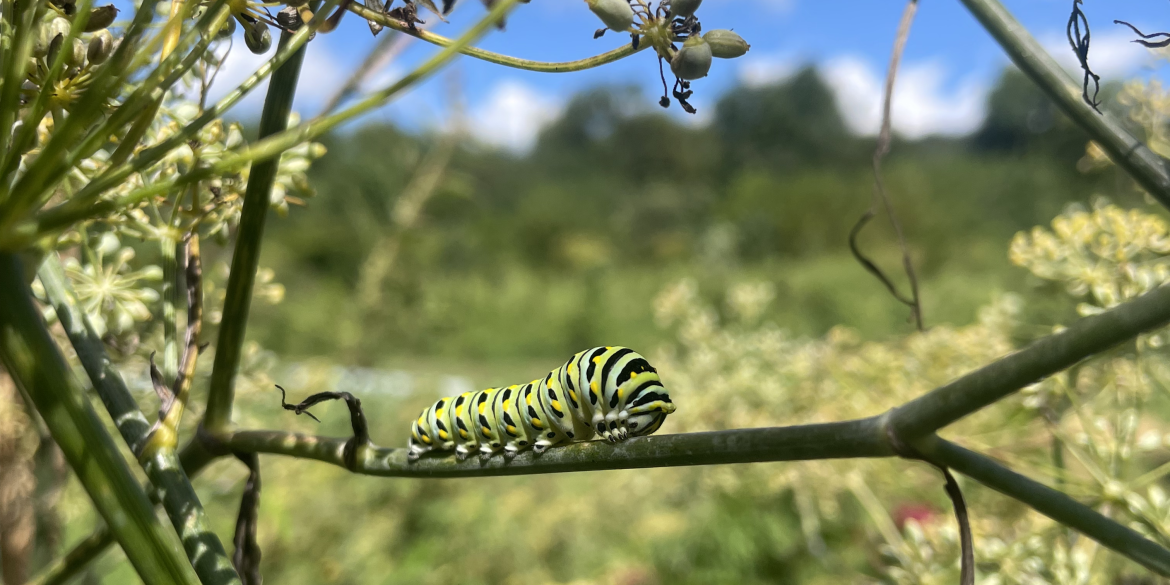
Building biodiversity is a key component of regenerative farming. When nature inspires how we design our food systems, a colorful cast of characters is bound to follow. That’s why we’re always excited to spot an unfamiliar or eye-catching insect in the field!

Don’t be fooled by their small stature: insects can provide a lot of ecological insights. In documenting both new and frequent sightings, we’ll explore questions like: Who do they eat? Who eats them? What habitats do they prefer? What plants do they depend on? If some consider them a “pest,” why? Is the judgment valid? Might there be a missing check – a predator or parasitoid, say – that could quell their impact? The vast majority of insects – many say over 99% – are harmless or beneficial to humans, so it’s worth taking the time to better understand those with whom we share our garden and farm ecosystems.

The 2026 growing season has been no exception for spotting cool bugs with even cooler life histories. Below are a few of the latest visitors to greet our staff, students, and volunteers this year. As you’ll see, even the smallest creatures can fill us with wonder, giving us countless pathways to connect with our local landscape.

Walnut Sphinx Moth (Amorpha juglandis)
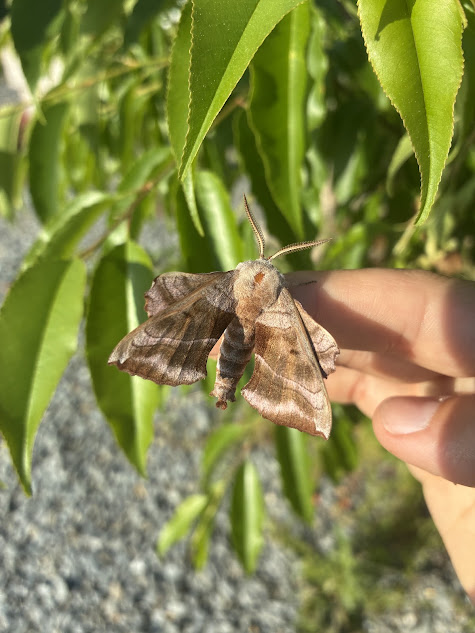
Walnut Sphinx Moth (Amorpha juglandis), photographed May 18, 2026

With so many black walnut trees surrounding our growing field, the name for this common moth came as no surprise. As caterpillars, walnut sphinx moths eat the leaves of black walnut (Juglans nigra) and related trees like butternut and hickories. Interestingly, they also consume hazelnut leaves. The Horn Farm’s multifunctional riparian buffer includes hundreds of American hazelnuts (Corylus americana) planted to protect sensitive land while producing edible nuts. So, if nothing else, the Horn Farm apparently provides pristine reproductive habitat for Amorpha juglandis!

But this quaint lepidopteran – belonging to the order of insects that includes butterflies, moths, and skippers – comes from surprisingly ferocious stock. Walnut sphinx moth caterpillars are known to thrash, bite, and even squeal when distrurbed. While the squealing reaches frequencies undetectable by the human ear, birds perceive the sounds and may become startled enough to skip the screaming caterpillars for their next meal.

But all this protest isn’t just pandemonium. Researchers have noticed how the caterpillar’s squeals resemble avian alarm signals, similar to those used by birds to communicate the presence of nearby predators. So it’s possible that the caterpllars are deflecting hungry birds by employing false alarms. Mimicry or chaos, this adaptation proves useful for keeping bird pressure at bay, allowing many caterpillars to survive the treacherous journey to becoming moths.

Eastern Elderberry Borer (Desmocerus palliatus)

American black elderberry (Sambucus canadensis), like American hazelnut, is a hallmark of the Horn Farm’s learning landscape. Dozens of class participants and volunteers have helped our team to plant, tend, and harvest hundreds of elderberries over the years, with the goal of creating a healthier farm ecosystem while demonstrating agroforestry to our community.

So, swimming as we are in a sea of elderberries, one would expect us to come across something like the eastern elderberry borer more often. This insect has an exclusive (or as ecologists would say, obligate) relationship with elderberry, requiring it for feeding and reproduction. But it turns out the elderberry borer is elusive, even for entomolgists. Many accounts describe it to this effect: “not uncommon, but rarely seen.”

The eastern elderberry borer is a species of longhorn beetle (Cerambycidae), and among the most visibly striking of this group. Its draping, iridescent wings are crowned with brilliant orange, a type of warning coloration designed to signal toxicity to birds and other predators. Some insects merely mimic warning coloration – like the viceroy butterfly vis-à-vis the monarch – but the elderberry borer may truly be noxious. Since elderberry leaves naturally contain toxic cyanogenic glycosides, the feeding insect can accumulate these toxins and render itself undesireable to predators. Cyanogenic glycosides, by the way, are the same compounds that make elderberry leaves and raw fruits inedible to people. They transform into hydrogen cyanide when consumed. When processing elderberry fruit for medicine, we have to cook or dry them to neutralize the toxins and reap elderberry’s incredible immune-boosting benefits.
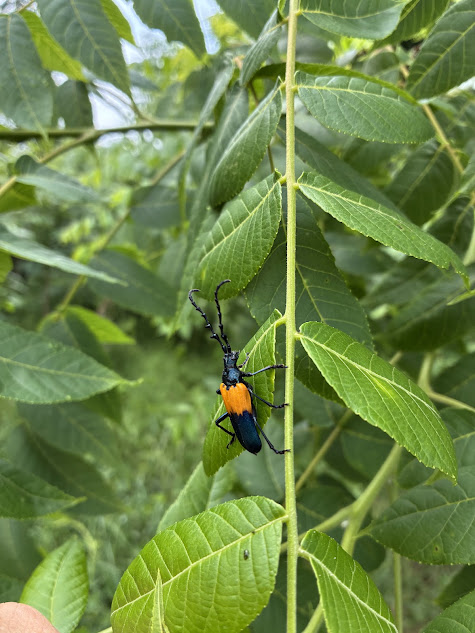
Eastern elderberry borer (Desmocerus palliatus), photographed June 9th

Now, if an insect called a “borer” rings any bells, you may be thinking of the emerald ash borer (Agrilus planipennis). This recent newcomer to North America has decimiated ash tree populations. As the name suggests, borers burrow beneath the bark of their host trees, creating holes and tunnels while feeding on essential nutrients. But not all borers are built the same. While it’s true that the larvae of the elderberry borer carve tunnels through elderberry as part of their life cycle, healthy stands of elderberry are rarely overwhelmed. Thanks to a long history of co-evolution and the borer’s generally low populations, there isn’t reason to believe this visitor poses any major encumbrance to our goals. With vigorous elderberries in an increasingly diversified community of plants and food webs, the eastern elderberry borer is simply another member of the whole.

White-Marked Tussock Moth (Orgyia leucostigma)
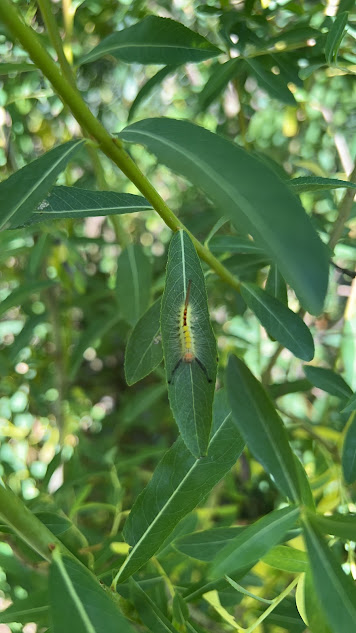
White-marked tussock moth (Orgyia leucostigma), photographed June 20th

This whimsical caterpillar was found clinging to a willow leaf in our basketry willow plot, making for a third new sighting among the agroforestry plantings. In fact, a volunteer discovered it while we harvested willow stems for make-your-own flower crowns at our Summer Solstice Market!

We left this stem uncut, and keenly so. Despite its rather Seussical appearance, this caterpillar is known to cause contact dermatitis, even leaving a rash on sensitive skin. That’s because of the arsenal of barbed hairs found across it’s body. These are concentrated in the antennae-like structures portruding from both ends and the four puffed clumps lining its abdomen. Even the protective cocoons these caterpillars spin during metamorphosis can cause irritation when touched!

Unlike the pickier insects above, the tussock moth is a generalist when it comes to feeding. They’ve been documented eating the foliage of over 140 plant species, primarily trees, both deciduous and coniferous. In fact, when localized population surges do occur, they can be pinned as pests in orchards and tree farms. But outbreaks are generally limited to a single season, and a healthy mix of predators, parasitoids, and pathogens – encouraged by a diversity of plants – can help prevent incursions in the first place.

It might seem unusual that the female moths are naturally flightless, a condition called brachyptery. In a world where dispersing genetics is generally encouraged, doesn’t this pose a disadvantage? As it turns out, the caterpillars themselves compensate for this shortcoming. Thanks to their ability to create short strands of fine silk, very young caterpillars can make like balloons, catching a good breeze and floating to new feeding sites. Appropriately, this travel technique is called ballooning. And with well over a hundred plant species on their menu, tussock moths are bound to land someplace where they can find a bite to eat – like the willow patch at the Horn Farm.

Black Swallowtail Caterpillar (Papilio polyxenes)

Compared with the insects above, the black swallowtail caterpillar is a relatively common find during the summer. The same goes for its stunning adult form, often seen flitting among the pollinator plots planted by our Ecological Gardener Training Program students over the years. But despite its frequency, we’re always willing to pause and admire this charming visitor to our vegetable and herb beds.

Gardeners who grow plants in the carrot family, Apiaceae, likely share our familiarity with the black swallowtail. Caterpillars feed exclusively on members of this botanical grouping, which includes celery, dill, fennel, parsley, and, of course, carrot. Apiaceae also includes wild and feral kin to our garden staples. Alongside golden alexander, wild parsnip, and Queen Anne’s lace (or wild carrot), it’s not uncommon to find black swallowtail caterpillars nonchalantly dining on some of North America’s deadliest plants, like poison hemlock and water hemlock. As any forager knows, one being’s dinner could be another’s trip to the ER!

Like the white-marked tussock moth, the black swallowtail caterpillar packs a bigger punch than its appearance suggests. Lacking in hairy armor, it conceals a secret, smelly weapon. When threatened, the caterpillar can retract its head and expose a pair of orange horns called osmeteria. The bright coloration of these horns acts as a visual warning, and they emit a foul-smelling secretion that helps to repel attackers.
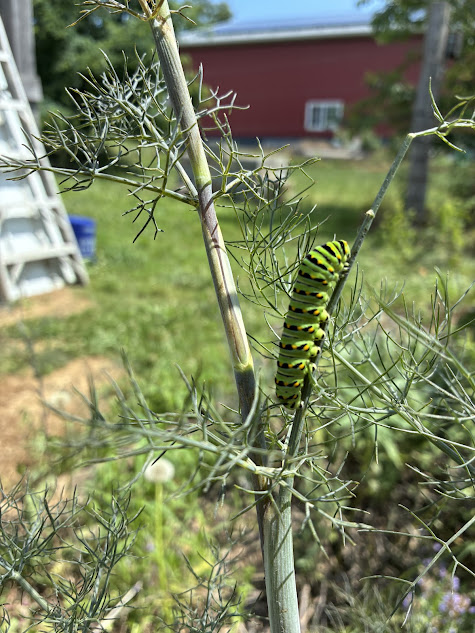
Black swallowtail caterpillar (Papilio polyxenes), photographed June 29th

While mature caterpillars employ this dramatic line of defense, younger caterpillars are a bit more subtle. Many people fail to recognize the early black swallowtail caterpillars as the same species, because they are very dark and spiny with a white splotch mark mid-way down their abdomen. These features may mimic bird droppings, helping them go undetected until they grow into their greener, more recognizable form. These incredible adaptations – visual, aromatic, and otherwise – help many caterpillars complete the perilous journey to pupation, after which they emerge as the iconic butterflies we associate with the summer.

Small Wonders Abounding

Growing food in ecological ways nourishes more than just the body. When we use nature’s designs to create diverse edible ecosystems, other benefits flutter, crawl, and inch our way. A lengthy summer day tending plants and harvesting food is always brightened when we find these signs of life. They may be small, but in filling us with curiosity, wonder, and admiration for the living world, they help to nourish our connection to the local landscape.

We’re grateful for the insects who surprise us each day. We’re also grateful for the students, volunteers, and other members of the Horn Farm community who share our fascination! Check out upcoming ways to get engaged with our educational ecosystem:

“Activated” by Biochar: A Boon for Building Soil

Late winter and early spring make one thing clear about agroforestry: it produces lots of sticks!

As the Horn Farm continues to develop agricultural teaching spaces informed by agroforestry–an approach to farming that integrates trees and shrubs to produce abundant and ecologically healthy landscapes–we’re finding that the “yields” go far beyond the berries and nuts. To start this growing season, volunteers and staff coppiced willows, harvested live stakes, and pruned elderberries, all producing one common denominator. Before we knew it, we had imposing pile of “biomass”: dead branches, sticks, and twigs galore!

By thinking like an ecosystem, farmers, gardeners, and land stewards know that a dry pile of branches isn’t the end of the line. Decomposing wood makes for great habitat, either left untouched or assembled into wildlife stacks in woodland areas. Or, with just some biodegradable twine and muscle, surplus wood can be tied into tight brushwood bundles and placed along the edges of streams, capturing sediment and helping to curb erosion in riparian areas. We could even ignite our biomass harvest into a bonfire, enjoy some s’mores, and call it a day!

But there’s another, more direct way to leverage a pile of wood for the continued nourishment of the soil that produced it: biochar.

Earlier this June, we invited longtime horticulturist and friend of the farm Dale Hendricks to provide a public demonstration on producing biochar at a home scale. With juicy mulberries in tow, Dale gave a stirring talk on the history and science of biochar, which has its roots (like many ecological farming practices) in Indigenous land management, from the Amazon to Africa. Producing biochar has helped people across history maintain fertile, abundant landscapes, taking the surplus that the land provides and returning it to the soil in way that concentrates what plants need most to thrive.

Put simply, biochar is made through burning woody biomass in a high-heat, low-oxygen environment. This controlled burning method generates a charcoal-like substance that can be added to soil to:

  • Improve water retention,
  • Enhance nutrient availability,
  • Foster healthy microbes, and
  • Keep excess carbon out of the atmosphere by storing it in the ground long-term.

There are many ways to produce biochar, with different designs based on scale. Pit and pyre burns are used for larger quantities of biomass, while for the small farm or home garden, Dale demonstrated a low-tech, two-barrel arrangement. This set-up manages the oxygen level while producing a very hot fire, creating the conditions needed to break down tightly-packed biomass into charcoal. Even with passing rain showers during the burn, it took about 40 minutes to transform hundreds of elderberry, willow, and assorted other sticks into readily usable biochar.

Like agroforestry itself, biochar is an empowering example of small-scale solutions to global environmental problems. With 100% local materials and simple methods, farmers, gardeners, and land stewards can use woody surplus to generate a stable form of carbon, improving soils while reducing atmospheric CO2–a major greenhouse gas contributing to climate change.

While students walked away with ideas for producing their own biochar at home, our staff is looking forward to integrating biochar production into our regular rotation of land management. As we continue our agroforestry journey, it’s increasingly clear that we’ll have no shortage of stems and twigs to transform into biochar, offering another way to close loops and create a self-sufficient ecological farm.

But land stewardship is just the first part of the story. Through community classes and programs exploring topics like biochar, we’ll continue to empower folks from across our region with the skills to work with the land in restorative, resourceful, and mutually beneficial ways.

As one student shared after the program: “I’m grateful for opportunities like this to learn and grow, and I’m looking forward to seeing what other workshops will be offered in the future.

2024 Training Program Graduate Spotlight

A Small Space for All:

An Ecological Gardener’s Story in Bringing Nature Home

Welcoming its fourth year in 2025, the Ecological Gardener Training Program with Waxwing EcoWorks brings together hands-on skill-building and in-depth exploration of our relationship with the natural world. Over 16 weekly classes, the program equips community members with the tools to design and nurture healthy habitat gardens while advocating for the wellbeing of our local ecosystems.

As we begin enrolling the next cohort of Ecological Gardener trainees, we checked in on one of our 2024 graduates, Susan, who is using what she learned in the program to transform her property near Lancaster, PA into an oasis for native biodiversity.


It’s a typical drive through the Lancaster countryside to get to Susan’s home outside of Strasburg. Little floating islands of rural suburbia wade in a sea of cropland and pasture. A tale of two landscapes unfolds out here: farmland and lawn. We might consider the tractor a keystone species in this human-made ecosystem. 

But pulling up to Susan’s property, I’m caught by a change of scenery. I dock my vessel on a special island where the tractor is losing ground, literally.

A tawny carpet of leaf litter sweeps across the front slope where, just a month ago, turfgrass reigned supreme.

It’s the antithesis of seasonal lawn care. Rather than being diligently raked and hauled away, these leaves are here to stay: the foundation of fecundity; an ecosystem-in-progress. 

In eco-gardening parlance, Susan’s steep, northwest-facing front lawn is inspired by sedge meadow ecology. Over 1700 plugs poke out of the leaf mulch like tacks on a corkboard, now setting roots for next spring’s growth. This community consists of four different species of sedges (Carex spp.) peppered with showier characters like red cardinal flower (Lobelia cardinalis), eastern beebalm (Monarda bradburiana), hairy beardtongue (Penstemon hirsutus) and, fittingly, Black-eyed Susan (Rudbeckia fulgida var. deamii). Such an arrangement was intentional for this highly visible space, balancing splendid variation and density with a garden-like presentation apropos for the public gaze.

Susan–who likes to go by Susie–tells me that the planting has already stirred curiosity from neighbors. She welcomes the conversations as a way to encourage folks to see our living spaces anew. “Native gardening promotes dialogue and encourages people to react in a different way,” she tells me later on, reflecting on how her experience in the Horn Farm’s Ecological Gardener Training Program expanded her perspective on the power of a small planted space. In this residential setting, she sees an opportunity to foster not just ecological health, but a revival of our relationship with nature: a pathway toward more positive, healing interaction with the land and each other.

Setting Roots and Sending Shoots

Like many folks who find their way into the rabbit hole of ecological restoration, Susie has always been fond of natural spaces. An avid hiker and frequenter of local preserves, curiosity brought her to the Lancaster Conservancy’s Habitat Advocate Classes in 2023. These experiences helped transform her appreciation into conviction about the importance of reviving nature in ecologically bereft spaces (read: lawns). 

Newly retired and ready to take action, she decided to enroll in the Horn Farm’s 2024 Ecological Gardener Training Program (EGTP). From February through May, 2024, weekly classes and field trips helped her move from tinkering with native plants at home to making intentional and informed design choices. When it came to the personal project that students undertake in the course, Susie’s focus was a shoe-in. She would set aside part of her yard to apply design tips and install a planting. In the ensuing months, the project would take off like any landscape spared of the tractor blade: blossoming exponentially. 

And so here I was, admittedly baffled when Susie led me first to the backyard to start our property tour. As it turns out, her sedge meadow slope is only the latest iteration in a yard-wide vision launched by the EGTP. In fact, the slope is the product of hiring on the Waxwing EcoWorks team; the rest of the yard is her own enterprise. Around back we visit a 700 sq ft area bordering the property corner–her “original” project site–now covered likewise with a thick carpet of mulch.

With the enthusiasm of a composer explaining her score, Susie conveys to me how the EGTP gave her the rudiments she needed to make work like this more approachable and digestible–to take ownership over something that seemed like a landscaper’s specialty. “It feels much better than taking a shot in the dark” she tells me. In rhythm with the hands-on lessons covered by the course, Susie got to work at home: measuring out the space, calculating plug counts, sheet mulching (localizing the impact by sourcing wood chips from down the road), testing the soil, assessing land use history, and observing the area’s ecological indicators to whittle down a plant palette.

I’m enamored by her self-assurance and excitement as we study her designs: a preview of what’s to come. For Susie, a big plus of the EGTP was bringing the otherwise esoteric concept of “design,” down to earth. Many aspiring eco-gardeners are paralyzed before they begin, mired in questions about where to place plants, how to space them, how they’ll behave, and, of course, what on earth to put in the ground.

Through the EGTP, Susie figured out how to navigate the overwhelm of options, coming up with a design that integrates function, habitat value, and year-around enjoyment.

It was far from desk work. When we talk about bringing “design” down to earth, we mean it literally.

A crucial part of Susie’s process was visiting local preserves with similar qualities in the baseline landscape: glimpses of what her property, centuries ago, might have looked like. She borrowed inspiration from the Lancaster Conservancy’s Shiprock Woods Nature Preserve alongside native meadowlands managed historically by fire. Coupling these references with the current state of her space, which bears a legacy of agricultural use, she arrived at a point of clarity about what her mini-habitat would be best equipped to host, and maybe even aspire to.

The resulting design is a thoughtful arrangement of 14 species. Different layers (from groundcovers to understory trees) allow her to maximize the square footage for biodiversity. Touchingly, the vision includes a seating space to enjoy the garden up close and personal–another echo of the training program’s teachings. In designing spaces for ecological health, we’re not just setting aside parcels of nature: we’re allowing ourselves to be part of the healing. We’re not ecological islands, after all. 

Diverse Refugia, all at Home

Any ecological gardener will tell you that sheet-mulching a lawnscape is enormously satisfying. Susie is no exception; in fact, with extra mulch and cardboard to spare, the process became infectious. What began as a relatively isolated project to mend a corner patch of her yard has now threaded its way into a quilt of activities across the property, including a natural border along the property line, re-designed landscaping around the back patio, and, of course, the whole front yard with her new friends at Waxwing.

One can venture to guess that 30-40% of the landscape is now set aside for ecological gardening bliss.  

As we survey these other works-in-progress, Susie shares with me another lesson gleaned from the EGTP. Even a modest-sized property like hers has its fair share of microhabitats. Little patches of yard here and there might have subtle differences in hydrology, soil drainage, shade, contour, and direction–all ecological “foundations” that suggest the suite of plants best suited for one area versus another. Inspired by the EGTP’s field trips to local reference landscapes, Susie took notice of the surprising variations that span her home turf. She closely observed existing conditions and found parallels within local habitats and plant communities. Rather than imposing her whimsy on the land, she has relied on the land’s wisdom to guide decisions.

There are many pathways for restoring a piece of earth, but when we build relationships with landscapes around us and listen, we’ll find that we’re not alone as restoration designers.

And so, in just a few steps, we move from a planned patch of shade-tolerant shrubs to a “hot and dry” exposed strip warranting meadow species. The area around the patio stacks even more functions, with a plan to install clumping grasses, buttonbushes (Cephalanthus occidentalis), and arrowwood viburnums (Viburnum dentatum) that can provide a natural buffer from runoff while dispersing water flows to other areas of the property. Wrapping up our stroll at the sedge-meadow hillside where we began, I can’t help but think of what this will look like in just a few year’s time. Take a sizable hike through multiple ecological communities, and condense it to a few paces around a house. A spot of refuge for a whole region, in a time when nature needs all the refuge it can get.

For all the savory nuances of design, reference landscapes, and plants, the lesson here is simple:

Plants are valuable allies for the shared well being of ourselves and the natural spaces we depend on, even in the smallest patch of land.

Like a heap of scraps becoming compost, just another area of turfgrass in tractor heaven is being deliberately turned over to the benefit of all life. As Susie puts it to me, the Ecological Gardener Training Program helped her see the potential of “taking small spaces and making them better for the world.”

Susie waters her front yard sedge meadow after site prep and planting are completed with the help of Waxwing EcoWorks (image provided by Susie).

The Joy in the Little Worlds

The EGTP is an incredible resource for practical insight. But for most trainees, Susie included, it also inspires introspection. She now sees ecological gardening as more than just a means to a regenerative end. She sees it as a process: an unfolding interaction between humans and the nature of which we’re a part–a rediscovery of our place in the landscape, rather than above it. She is motivated by the notion of reparation: of paying back for our extractive relationship with the land. Overall, she sees ecological gardening as an act of love: an invitation to work with the land rather than against it. 

She recalls to me the transformation that emerged in her as the class progressed, inspired by the attention to detail that came with observing plants on the landscape:

“I learned how to see plants in a different way. All of a sudden, I was seeing all the things I didn’t know I didn’t know.”

She jokingly shares with me how she can no longer take a casual stroll through meadow or forest, always pulled to the trail’s edge by another fascinating seed head; a pairing of plants; the finer elegance of those common species often overlooked in their ubiquity: of mayapples, Virginia waterleaf, and meadow grasses. Seeing all of this beauty in the seemingly mundane underlines her commitment to bring nature home, and she feels this is a deeper gift of the program–that invitation to deep noticing, which may be just as healing to people as the action we take to restore the land.

I stop to take a picture of Susie posing in front of her sedge meadow slope. Below to my left, I catch a glimpse of something peculiar in the basal green of a wild violet (a volunteer, but welcome in a place like this). We peer in to sight a red caterpillar circled with black studs like cactus needles. Susie gasps with exhilaration, and in that moment I can hear the truth of the love she’s told me about. “That’s a fritillary!” she exclaims. A variegated fritillary (Euptoieta claudia) like this has piqued her interest before; she spotted one while going about her eco-gardening routines some time ago, and it spurred her into a flurry of research. She’s always interested in learning more about who she’s building habitat for.

Just a few short steps from the road, a variegated fritillary caterpillar (Euptoieta claudia) happily munches away in Susie’s front yard meadow planting.

“I’ve already seen, even at the beginning, more happy critters here than I’ve seen before.”

That’s a promising foretelling for an island of biodiversity that’s only just starting to bloom. And with the help of the Ecological Gardener Training Program, more and more folks across the region are planting refuges like this, and not just independent homeowners like Susie. Ecological landscaping professionals, community doers, teachers, and advocates are popping up like plugs in leaf mulch, all inspired to turn the tide and re-balance our relationship with the wild spaces we depend on.

It’s only a matter of time before little islands like Susie’s merge into a continent.


Join the Ecological Gardener Training Program in 2025!

Registrations close on Monday, January 27th at 12PM EST.

Over 16 weeks of hands-on learning with our educational partner Waxwing EcoWorks, trainees dig deep into designing and nurturing native plant habitat to help build back biodiversity in the places we live, work, and play. Learn more and let us know you’re interested at hornfarmcenter.org/ecological-gardener-training/

Scholarships are available to offset program costs.

Trainees in the 2024 Ecological Gardener Training Program. Image courtesy of Elyse Jurgen (Waxwing EcoWorks)

About the Author: Andrew Leahy

Growing up in the foothills of Ricketts Glen State Park, Andrew spent his early life in the embrace of Northeastern PA forests, sowing the seeds for his ongoing enchantment with the natural world and its stewardship. While studying English and Music Composition at Muhlenberg College, he gravitated toward nonprofit engagement as a work study student in the college’s Office of Community Engagement. Now, going on three years at the Horn Farm Center, Andrew manages social media, develops and teaches educational programs, coordinates volunteer events, and collaborates on marketing projects, large events, and organizational capacity-building. Through all of this, he is a dedicated student of the land, with a life’s mission of learning (and providing spaces for others to learn) about bioregional ecology, regenerative agriculture, permaculture, foraging, and locally-focused ways of living in reciprocal relationship with nature. Andrew has completed the Horn Farm’s Land Steward Training Program (2023), Ecological Gardener Training Program (2024), and teaches monthly foraging walks, alongside co-teaching the Horn Farm’s new Forager Training Program.