Tag Archive: Regenerative

Finding Wonder in the Smallest Surprises
Building biodiversity is a key component of regenerative farming. When nature inspires how we design our food systems, a colorful cast of characters is bound to follow. That’s why we’re always excited to spot an unfamiliar or eye-catching insect in the field!

Don’t be fooled by their small stature: insects can provide a lot of ecological insights. In documenting both new and frequent sightings, we’ll explore questions like: Who do they eat? Who eats them? What habitats do they prefer? What plants do they depend on? If some consider them a “pest,” why? Is the judgment valid? Might there be a missing check – a predator or parasitoid, say – that could quell their impact? The vast majority of insects – many say over 99% – are harmless or beneficial to humans, so it’s worth taking the time to better understand those with whom we share our garden and farm ecosystems.

The 2026 growing season has been no exception for spotting cool bugs with even cooler life histories. Below are a few of the latest visitors to greet our staff, students, and volunteers this year. As you’ll see, even the smallest creatures can fill us with wonder, giving us countless pathways to connect with our local landscape.

Walnut Sphinx Moth (Amorpha juglandis)
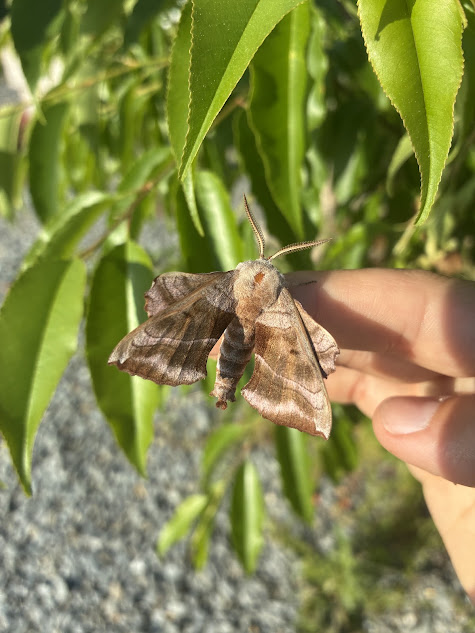
Walnut Sphinx Moth (Amorpha juglandis), photographed May 18, 2026

With so many black walnut trees surrounding our growing field, the name for this common moth came as no surprise. As caterpillars, walnut sphinx moths eat the leaves of black walnut (Juglans nigra) and related trees like butternut and hickories. Interestingly, they also consume hazelnut leaves. The Horn Farm’s multifunctional riparian buffer includes hundreds of American hazelnuts (Corylus americana) planted to protect sensitive land while producing edible nuts. So, if nothing else, the Horn Farm apparently provides pristine reproductive habitat for Amorpha juglandis!

But this quaint lepidopteran – belonging to the order of insects that includes butterflies, moths, and skippers – comes from surprisingly ferocious stock. Walnut sphinx moth caterpillars are known to thrash, bite, and even squeal when distrurbed. While the squealing reaches frequencies undetectable by the human ear, birds perceive the sounds and may become startled enough to skip the screaming caterpillars for their next meal.

But all this protest isn’t just pandemonium. Researchers have noticed how the caterpillar’s squeals resemble avian alarm signals, similar to those used by birds to communicate the presence of nearby predators. So it’s possible that the caterpllars are deflecting hungry birds by employing false alarms. Mimicry or chaos, this adaptation proves useful for keeping bird pressure at bay, allowing many caterpillars to survive the treacherous journey to becoming moths.

Eastern Elderberry Borer (Desmocerus palliatus)

American black elderberry (Sambucus canadensis), like American hazelnut, is a hallmark of the Horn Farm’s learning landscape. Dozens of class participants and volunteers have helped our team to plant, tend, and harvest hundreds of elderberries over the years, with the goal of creating a healthier farm ecosystem while demonstrating agroforestry to our community.

So, swimming as we are in a sea of elderberries, one would expect us to come across something like the eastern elderberry borer more often. This insect has an exclusive (or as ecologists would say, obligate) relationship with elderberry, requiring it for feeding and reproduction. But it turns out the elderberry borer is elusive, even for entomolgists. Many accounts describe it to this effect: “not uncommon, but rarely seen.”

The eastern elderberry borer is a species of longhorn beetle (Cerambycidae), and among the most visibly striking of this group. Its draping, iridescent wings are crowned with brilliant orange, a type of warning coloration designed to signal toxicity to birds and other predators. Some insects merely mimic warning coloration – like the viceroy butterfly vis-à-vis the monarch – but the elderberry borer may truly be noxious. Since elderberry leaves naturally contain toxic cyanogenic glycosides, the feeding insect can accumulate these toxins and render itself undesireable to predators. Cyanogenic glycosides, by the way, are the same compounds that make elderberry leaves and raw fruits inedible to people. They transform into hydrogen cyanide when consumed. When processing elderberry fruit for medicine, we have to cook or dry them to neutralize the toxins and reap elderberry’s incredible immune-boosting benefits.
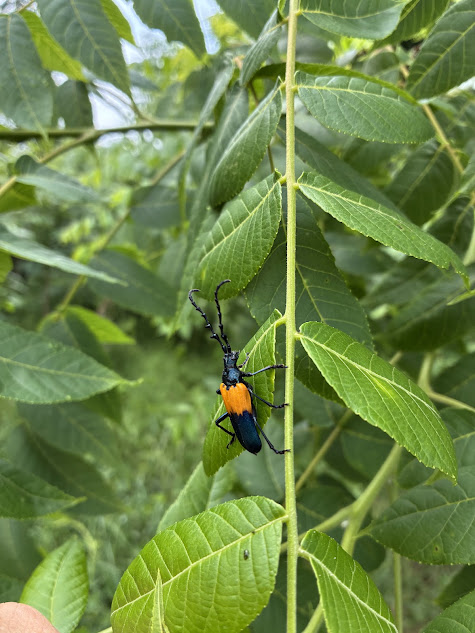
Eastern elderberry borer (Desmocerus palliatus), photographed June 9th

Now, if an insect called a “borer” rings any bells, you may be thinking of the emerald ash borer (Agrilus planipennis). This recent newcomer to North America has decimiated ash tree populations. As the name suggests, borers burrow beneath the bark of their host trees, creating holes and tunnels while feeding on essential nutrients. But not all borers are built the same. While it’s true that the larvae of the elderberry borer carve tunnels through elderberry as part of their life cycle, healthy stands of elderberry are rarely overwhelmed. Thanks to a long history of co-evolution and the borer’s generally low populations, there isn’t reason to believe this visitor poses any major encumbrance to our goals. With vigorous elderberries in an increasingly diversified community of plants and food webs, the eastern elderberry borer is simply another member of the whole.

White-Marked Tussock Moth (Orgyia leucostigma)
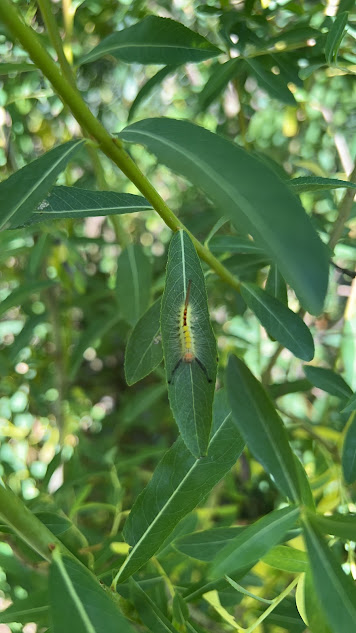
White-marked tussock moth (Orgyia leucostigma), photographed June 20th

This whimsical caterpillar was found clinging to a willow leaf in our basketry willow plot, making for a third new sighting among the agroforestry plantings. In fact, a volunteer discovered it while we harvested willow stems for make-your-own flower crowns at our Summer Solstice Market!

We left this stem uncut, and keenly so. Despite its rather Seussical appearance, this caterpillar is known to cause contact dermatitis, even leaving a rash on sensitive skin. That’s because of the arsenal of barbed hairs found across it’s body. These are concentrated in the antennae-like structures portruding from both ends and the four puffed clumps lining its abdomen. Even the protective cocoons these caterpillars spin during metamorphosis can cause irritation when touched!

Unlike the pickier insects above, the tussock moth is a generalist when it comes to feeding. They’ve been documented eating the foliage of over 140 plant species, primarily trees, both deciduous and coniferous. In fact, when localized population surges do occur, they can be pinned as pests in orchards and tree farms. But outbreaks are generally limited to a single season, and a healthy mix of predators, parasitoids, and pathogens – encouraged by a diversity of plants – can help prevent incursions in the first place.

It might seem unusual that the female moths are naturally flightless, a condition called brachyptery. In a world where dispersing genetics is generally encouraged, doesn’t this pose a disadvantage? As it turns out, the caterpillars themselves compensate for this shortcoming. Thanks to their ability to create short strands of fine silk, very young caterpillars can make like balloons, catching a good breeze and floating to new feeding sites. Appropriately, this travel technique is called ballooning. And with well over a hundred plant species on their menu, tussock moths are bound to land someplace where they can find a bite to eat – like the willow patch at the Horn Farm.

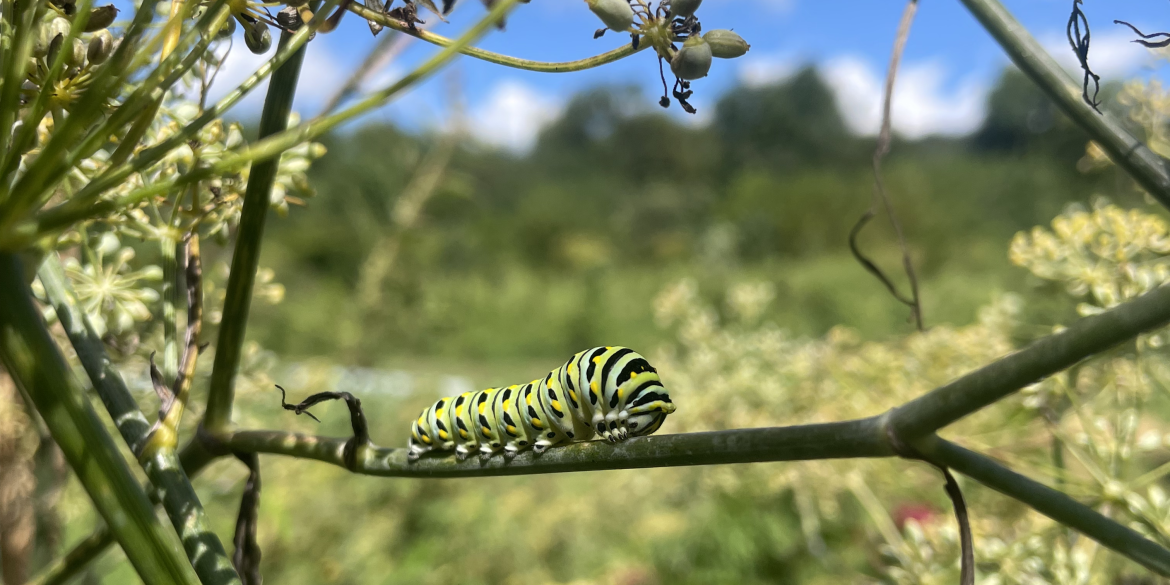
Black Swallowtail Caterpillar (Papilio polyxenes)

Compared with the insects above, the black swallowtail caterpillar is a relatively common find during the summer. The same goes for its stunning adult form, often seen flitting among the pollinator plots planted by our Ecological Gardener Training Program students over the years. But despite its frequency, we’re always willing to pause and admire this charming visitor to our vegetable and herb beds.

Gardeners who grow plants in the carrot family, Apiaceae, likely share our familiarity with the black swallowtail. Caterpillars feed exclusively on members of this botanical grouping, which includes celery, dill, fennel, parsley, and, of course, carrot. Apiaceae also includes wild and feral kin to our garden staples. Alongside golden alexander, wild parsnip, and Queen Anne’s lace (or wild carrot), it’s not uncommon to find black swallowtail caterpillars nonchalantly dining on some of North America’s deadliest plants, like poison hemlock and water hemlock. As any forager knows, one being’s dinner could be another’s trip to the ER!

Like the white-marked tussock moth, the black swallowtail caterpillar packs a bigger punch than its appearance suggests. Lacking in hairy armor, it conceals a secret, smelly weapon. When threatened, the caterpillar can retract its head and expose a pair of orange horns called osmeteria. The bright coloration of these horns acts as a visual warning, and they emit a foul-smelling secretion that helps to repel attackers.
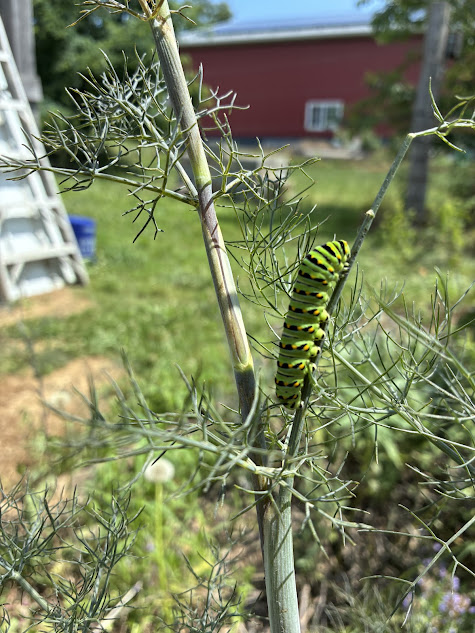
Black swallowtail caterpillar (Papilio polyxenes), photographed June 29th

While mature caterpillars employ this dramatic line of defense, younger caterpillars are a bit more subtle. Many people fail to recognize the early black swallowtail caterpillars as the same species, because they are very dark and spiny with a white splotch mark mid-way down their abdomen. These features may mimic bird droppings, helping them go undetected until they grow into their greener, more recognizable form. These incredible adaptations – visual, aromatic, and otherwise – help many caterpillars complete the perilous journey to pupation, after which they emerge as the iconic butterflies we associate with the summer.

Small Wonders Abounding

Growing food in ecological ways nourishes more than just the body. When we use nature’s designs to create diverse edible ecosystems, other benefits flutter, crawl, and inch our way. A lengthy summer day tending plants and harvesting food is always brightened when we find these signs of life. They may be small, but in filling us with curiosity, wonder, and admiration for the living world, they help to nourish our connection to the local landscape.

We’re grateful for the insects who surprise us each day. We’re also grateful for the students, volunteers, and other members of the Horn Farm community who share our fascination! Check out upcoming ways to get engaged with our educational ecosystem:

A Summer Symphony with the Regenerative Grower Training Program

As summer arcs toward the fall, the Horn Farm’s demonstration field sings with the signs of the harvest season.

Ripening tomatoes and swelling squashes carry the melody, buttressed by the harmonies of murmuring pollinators as they flutter about the wildflower meadows. In the spaces between, seedlings of fall crops emerge from newly-prepped soil, balancing the tune like altos.

Even on the most humid days, it’s a performance to savor!

Behind this chorus, six students in the Regenerative Grower Training Program (RGTP) have become both composers and audience. As they pass the half-way point of this 22-week immersion, Tam Shertzer – co-instructor for the course – reflects on the ways the season has changed not just for the land, but for this first cohort of Regenerative Growers:

It’s been exciting for me, as a first year staff member at Horn Farm, to be a part of developing the Regenerative Grower Training Program! This year’s participants are inquisitive and enthusiastic – there have been engaging conversations and wonderful opportunities for us all to learn from each other. Over the weeks we’ve spent together, folks have taken ownership of tending the land – asking the big questions, offering their ideas, and thinking like an ecosystem – which is ultimately one of the goals of this program.

Indeed, if there’s any chorus that has carried this program from the start, it’s thinking like an ecosystem. When approaching the land, students are encouraged to ask questions like: how does nature sustain itself? How can we mirror and honor this in designing systems for growing food?

How can living ecosystems inform the questions we ask and the decisions we make as growers?

The roles of “gardener,” “grower,” and “farmer” broaden when we look through this ecological lens. Rather than simply working on the land to obtain a yield, Regenerative Growers are seeing their place in partnership with the land – co-producing abundance by harnessing the wisdom that nature’s concert sings to us.

Tending to crops is just a part of the composition. In fostering regenerative systems, we also need to tend the soil, the water, and the surrounding ecology that support these crops in growing themselves.

After all, as the instructors like to say: the crops are doing most of the work anyway!

By positioning ourselves as tenders of the whole, our interactions with the land begin to resemble how growing food has always been, at least before the rise of industrial and chemically-dependent agriculture. Students are working at a small scale, within the parameters of our human and ecological limits. This carries its own challenges, lessons, and imperfections. As students can testify, it’s certainly not the bucolic vision that back-to-the-landers would make it seem. Nor is it air tight: we’re still self-consciously reliant on industrial vehicles, tools, and plastics (albeit recycled whenever possible). But as we continue to share insights, address shortcomings, enjoy yields, and lay groundwork for next season, we’re experiencing what makes ecologically-minded growing truly regenerative for the land and for people.

Read along to glean some of the skills and lessons students (and our staff!) have learned as we spend this first season of the RGTP together.

From the Ground Up: Ecological Growing in Action

So what does the music of the growing space sound like when we step back and listen with an ecological frame of mind? For one, the bass of the symphony becomes apparent like never before. Upholding all those melodies and harmonies, the earth beneath us – the soil – now captures our attention. What is easily overlooked as the drone underlying the ensemble is actually the remarkable, resolute foundation on which everything depends.

Tuning Into Living Soils, and Unlikely Allies

Students have prepped many growing beds this season, learning how to use the resources that the land provides to build soil vitality in both the near-term and over time. The best advice, as ecological thinking would have it, comes from the forest next door. Here, living, layered soils build themselves. With this model in mind, we’ve identified some basic tenants of soil health and applied them, including aeration, coverage, and foregoing the tiller to minimize disturbance (or maintain the bass line, so to speak. Ever heard a tune without a bass line? Eerie!).

Digging deep into soil ecology, students are becoming acquainted with some surprising allies for our soil-building efforts: weeds.

Gardeners are no strangers to the frustration of a weedy plot, but so-called “weeds” are what we make them, and for the regenerative grower, weeds can be a resource rather than a hinderance.

In natural systems, the opportunistic plants that take residence in disturbed and exposed soils are founding members of an unfolding story. “Weeds” literally lay the groundwork for soil fertility. These plants are so persistent not because they’re pernicious, but because they are prodigious at mining nutrients from soils where other plants would struggle to grow. When these nutrient-miners die back each growing season – which is the case for most plants we consider “weeds,” being annuals – they deposit their bounty onto the surface. Over time, mounting stocks of reclaimed nutrients fuel an increasingly complex soil food web, priming the ground for new plant communities to move in.

Using weeds to our advantage. Biomass in this bed was left in place to re-cover the soil after decompaction.

With this process in mind, students have applied a few techniques for prepping beds by incorporating rather than antagonizing weeds. Green mulching is one example, which entails pulling and cutting plants before they go to seed and laying them in place as nutrient-rich biomass. The benefits of green mulching are themselves layered – not only will decomposing plant matter feed soil microbiota and the plants we intend to grow, but the litter keeps the soil covered, maintaining moisture and temperature.

As a proponent of rethinking the role of weeds in the growing system, co-instructor and Farm Manager Jon Darby encourages everyone to know each weed and the services they provide.

For students, pulling a weed isn’t encouraged unless they can identify it first. Hence, weeding in the ecological growing space is a selective, mindful, and even meditative practice.

Many plants conventionally victimized by the trowel, the mower, or worse – the herbicide – are spared in this ethic, because their “weediness” is nullified by oft-overlooked benefits like feeding the soil, creating dappled shade, attracting beneficial insects, and, of course, providing free food and medicine (purslane, anyone?).

Harmony in Complexity: Mimicking Biodiversity

A symphony is a mosaic of sounds. As listeners, we’re captivated not by individual players, but by intentional groupings of instruments that dance with one another. Much the same can be said for healthy plant communities. Nature isn’t a stranger to monocrops – ecological succession, or natural changes in ecosystems over time, teaches us that plant communities can take many forms. But by and large, high diversity fosters productivity and a resilient whole.

With this frame of mind, RGTP students are learning how ecosystems can inspire how we map our crop systems. This doesn’t necessarily mean abandoning order. Rows and structures promote efficient harvests, and as members of the ecological community ourselves, it’s important to weigh our needs in the system. But even within limits, we can design plant communities that mirror how ecosystems are structured. In doing so, we also replicate the benefits of ecosystem structures, which buffer against weather, pest and disease pressure, and other unpredictable disturbances.

A classic example of this ecological planting style has deep roots on this continent. Testifying to the vast exchanges of knowledge and resources that traversed what we now call North America, countess Indigenous communities from the southwest to the Susquehanna Riverlands developed a method for planting three staple crops – corn, beans, and squash – in tight-knit groupings known as the Three Sisters. Many Indigenous farmers and growers continue to honor this legacy today, serving as leaders in ecological food production.

In a Three Sisters plot, each sister uplifts her two companions, enriching all three while creating a more resilient whole.

Towering corn provides sturdy scaffolding for vining beans to climb. In turn, the beans bring nourishment to the soil by increasing the availability of nitrogen. You may be familiar with beans as “nitrogen-fixers”; thanks to beneficial bacteria in their roots, beans and other legumes convert nitrogen from the atmosphere into a form that can be absorbed by plants, making them a choice cover crop in sustainable planting systems.

While beans and corn dance skyward in this way, their sibling, squash, delivers her own benefits on the ground below. Squash spreads horizontally, creating a dense and spiny understory that offers protection from herbivores while creating ample shade for the soil. She maintains everyone’s water reserves, even through the driest spells of summer, and her sisters return the favor: a nitrogen boost from beans, and gradual trickles of water from corn after rain.

The three sisters are just one time-tested example of what we can call plant guilds, or communities that, by virtue of their their togetherness, offer services for each of their members. RGTP students continue to engage with guilds and companionships that are informed by our our goals as growers. These goals can include soil-building (incorporating legumes), pest deterrence (alliums and brassicas), partitioning resources, and making the most of small spaces. Even aesthetics and “just for experiment’s sake” are valid goals for the playful fringes of the field (proving, for example, that fennel and peppers can indeed grow together!).

When it comes to companion planting, you’ll find no shortage of resources peddling overstated claims about which plants can and cannot go together. RGTP students take the extra steps of investigating the “whys” behind these claims, tracing plants back to the functions they serve within each mini-ecosystem we’re growing.

Critical thinking is another refrain that threads the course, as we interrogate commonly-held assumptions in gardening and farming that we often take for granted without knowing why. Why do we eradicate weeds and remove them from the planting space? Why do we till the soil? Do the benefits we presume outweigh the cons or create missed opportunities? What assumptions – ecological, generational, cultural, industrial – underlie conventional scripts about how food ought to be grown, or how we ought to handle problems like pests and diseases? What information, though conveyed to us as universal, is actually quite contextual to time, place, and growing conditions?

On that last query: working in such a place-based, context-specific medium as ecological growing, RGTP students are justifiably exhausted (and equally spurred!) by the same answer around every corner: “it depends …” It’s important to glean what we can from observable patterns across nature, but at the same time, we have to acknowledge the specific conditions of where we are growing to move forward with ecological sensibility and tact.

Orchestrating Perennials: Future Resilience from the Garden to the Farm

Most of the plants that take root across today’s farms and gardens are short-lived. Those that complete their entire life cycle in one growing season–germinating in the spring and dropping seeds by the fall–are called annuals. Think of tomatoes and all three sisters: corn, beans, and squashes. Biennials, you might then guess, complete their life cycle over two growing seasons, usually by producing hearty leaves in their first year and offspring in their second. Swiss chard, beets, and brassicas like kale and broccoli fall into this camp.

As the self-sustaining ecosystems neighboring our farms and gardens show us, however, nature tends toward perennials. These plants will live for multiple, even hundreds, of years, producing flowers, fruits, or other harvestable materials over many growing seasons without the need for re-planting or heavy intervention.

Let’s get back to thinking like an ecosystem here. Thinking in this way can only take us so far if we keep our sights fixed on the familiar archetypes of farming and gardening culture: the annuals and biennials.

The RGTP shows students how we can reimagine these conventional systems through ecological design, but ultimately, perennial gardens bring us closer than ever to the self-sufficiency and integration modeled by ecology.

So, while students have spent much of this season among the veggies, we’ve also taken time to dip our toes in the budding network of perennial growing systems taking root across the Horn Farm.

Tam shares how this element of the course brings not just new energy, but increasing importance to the course. After all, the RGTP is about equipping growers with versatile and adaptable skills, not just to foster healthy food ecosystems, but to do so through an uncertain future:

In the time that remains, I’m really looking forward to establishing (and re-establishing!) more perennial food spaces in our demo field. As the season progresses, and we’ve already seen some intense heat waves, the value of perennial systems has become more and more apparent. (Annuals are certainly worth the time and effort, but who doesn’t love a trusty mulberry tree that produces reliably every spring?!) I can’t wait to see what kinds of designs the RGTP participants create once they have the opportunity to put their brains into design mode. I’m expecting that some truly beautiful, diverse, and abundant spaces will take shape this year at Horn Farm!

On the ground at the Horn Farm Center, perennial growing systems are becoming increasingly common. Dense plantings of American black elderberries (Sambucus canadensis) line the edges of our demonstration field. Beneath alleys of mulberry (Morus alba), American plum (Prunus americana), and nut-bearing trees, herbaceous perennials like sochan (Rudbeckia laciniata) and bee balm (Monarda spp.) grace the soil. Even fallow plots awaiting new designs are arguably perennial, with their preponderance of edible “weeds” like nettles, dandelions, and violets regaling our foraging programs with enlarged notions of food.

As Tam mentions, long-lived perennial growing systems like these offer greater resilience in the face of an increasingly mercurial environment. Human-caused climate change has vexed our summers with extremes of heat, rain, and disease, but tree and shrub systems are better equipped for handling these pressures because they already do what we work so hard to replicate in the annual and biennial gardens. Their tenacious root systems keep the soil from eroding while managing inconsistent water inputs; their copious shade keeps soil cool on relentlessly sunny days; constant leaf debris and woody prunings feed soil biota continuously; and the crops they produce – especially nuts – offer us more calories, more versatility, and better storability than conventional crops.

Students in the RGTP have gotten a taste of agroforestry through engaging with growing spaces that incorporate trees, shrubs, and other long-lived plants at the Horn Farm. They’ve also glimpsed ways to design these kinds of systems, learning about food forests and forest gardening. As Tam mentions, they’ll soon be turning design into action, supporting the creation of demonstration forest gardens that will serve future iterations of the RGTP, classes for the general public, and, undoubtedly, the ecological web we’re creating across the Horn Farm’s educational landscape.

Perennial plants, agroforestry, and concepts like forest gardening sound newfangled to many, but they constitute some of the oldest agricultural interactions between humans and the land. What we today call agroforestry systems predate the advent of annual-based agriculture the world over. So while the thrust of the RGTP is about thinking like an ecosystem to rethink our roles as growers, a more accurate verb for our relationship with the land might be one rekindling, reigniting, even reintegrating. Returning to our roots as custodians of wellbeing and longevity, and in so doing, becoming perennial ourselves.

Cadence: Regenerative Pathways for Food and Community

Nestled among the demonstration gardens, one Three Sister’s plot conceals something peculiar. Peer through the squash leaves and you’ll see finger-like structures protruding from the bases of some of the corn. Bendy and blunted with gel-caked tips, these structures look like something out of a Seussical forest.

One of our students – an enthusiast for rare seeds – gifted us with kernels from a variety of corn known to fix nitrogen. Like the root nodules of legumes that host nitrogen-fixing bacteria, these structures – which are actually above-ground roots – perform a similar dance. They attract bacteria with sugar-rich mucilage in order to farm nitrogen from the atmosphere.

Upon planting this curious corn, the RGTP crew coined it “The People’s Corn.” The name stuck – a fond term of endearment for an experimental plot that, we hope, will yield nitrogen-fixing corn seed for future seasons. The People’s Corn is always on students’ minds: “How’s The People’s Corn?” “Let’s go check on The People’s Corn,” “Squash isn’t looking so hot in The People’s Corn.” “Ants are farming aphids in The People’s Corn!”

We’re all familiar with giving a namesake to something you love. For the Horn Farm, this makes The People’s Corn an emblem of the RGTP’s greater vision.

The least we can do is empower folks to regenerate the land and our relationship to it; in the grand scheme, we’re striving to regenerate peoples’ sense of connection with one another. Slowly but surely, by nurturing a healthier landscape together, we’re growing food, fodder, and well-(g)rounded community.

History shows us that food grown ecologically has always carried community. In fact, to work regeneratively with the land, we need community. The long game of rekindling an ecologically-imaginable food system demands as many tending and curious hands as we can muster. It’s a bold about-face to the trajectory that industrial agriculture has taken, severing more and more of us from the sources of our lives.

So when we lead with thinking like an ecosystem, mimicking ecology in the growing space is just part of the symphony. A thriving ecosystem is itself a network of players, each contributing to the whole.

Thus, through tending ecological food systems, nature also teaches us to tend and grow our communities.

We’re grateful to this year’s first RGTP for moving in that spirit with us; we’re just a small collective of caretakers dedicated to learning and growing with the land, but with resilient community-creation in the works – from the plants to the people – we’re sowing seeds for a regenerative future.

“Activated” by Biochar: A Boon for Building Soil

Late winter and early spring make one thing clear about agroforestry: it produces lots of sticks!

As the Horn Farm continues to develop agricultural teaching spaces informed by agroforestry–an approach to farming that integrates trees and shrubs to produce abundant and ecologically healthy landscapes–we’re finding that the “yields” go far beyond the berries and nuts. To start this growing season, volunteers and staff coppiced willows, harvested live stakes, and pruned elderberries, all producing one common denominator. Before we knew it, we had imposing pile of “biomass”: dead branches, sticks, and twigs galore!

By thinking like an ecosystem, farmers, gardeners, and land stewards know that a dry pile of branches isn’t the end of the line. Decomposing wood makes for great habitat, either left untouched or assembled into wildlife stacks in woodland areas. Or, with just some biodegradable twine and muscle, surplus wood can be tied into tight brushwood bundles and placed along the edges of streams, capturing sediment and helping to curb erosion in riparian areas. We could even ignite our biomass harvest into a bonfire, enjoy some s’mores, and call it a day!

But there’s another, more direct way to leverage a pile of wood for the continued nourishment of the soil that produced it: biochar.

Earlier this June, we invited longtime horticulturist and friend of the farm Dale Hendricks to provide a public demonstration on producing biochar at a home scale. With juicy mulberries in tow, Dale gave a stirring talk on the history and science of biochar, which has its roots (like many ecological farming practices) in Indigenous land management, from the Amazon to Africa. Producing biochar has helped people across history maintain fertile, abundant landscapes, taking the surplus that the land provides and returning it to the soil in way that concentrates what plants need most to thrive.

Put simply, biochar is made through burning woody biomass in a high-heat, low-oxygen environment. This controlled burning method generates a charcoal-like substance that can be added to soil to:

  • Improve water retention,
  • Enhance nutrient availability,
  • Foster healthy microbes, and
  • Keep excess carbon out of the atmosphere by storing it in the ground long-term.

There are many ways to produce biochar, with different designs based on scale. Pit and pyre burns are used for larger quantities of biomass, while for the small farm or home garden, Dale demonstrated a low-tech, two-barrel arrangement. This set-up manages the oxygen level while producing a very hot fire, creating the conditions needed to break down tightly-packed biomass into charcoal. Even with passing rain showers during the burn, it took about 40 minutes to transform hundreds of elderberry, willow, and assorted other sticks into readily usable biochar.

Like agroforestry itself, biochar is an empowering example of small-scale solutions to global environmental problems. With 100% local materials and simple methods, farmers, gardeners, and land stewards can use woody surplus to generate a stable form of carbon, improving soils while reducing atmospheric CO2–a major greenhouse gas contributing to climate change.

While students walked away with ideas for producing their own biochar at home, our staff is looking forward to integrating biochar production into our regular rotation of land management. As we continue our agroforestry journey, it’s increasingly clear that we’ll have no shortage of stems and twigs to transform into biochar, offering another way to close loops and create a self-sufficient ecological farm.

But land stewardship is just the first part of the story. Through community classes and programs exploring topics like biochar, we’ll continue to empower folks from across our region with the skills to work with the land in restorative, resourceful, and mutually beneficial ways.

As one student shared after the program: “I’m grateful for opportunities like this to learn and grow, and I’m looking forward to seeing what other workshops will be offered in the future.